No contractFree number transfer30-day money-back guarantee

See every price
Finish

Hang up. Keep your place.

Nobody should have to choose between holding and starting over. Callers ask for a callback, get on with their day, and their turn still comes.

  1. On hold. After a wait you choose, callers hear: “To keep your place in line and have us call you back, press nine.”
  2. They press 9. “You’re calling from (480) 555-0177. To receive your callback at this number, press 1. To enter a different number, press 2.”
  3. The call ends. “Thank you. We’ll call you back. Goodbye.” A stand-in holds their place.
  4. Their turn. The next free agent gets it like any call, marked Callback.
  5. Called back. The agent answers, Kafono dials, and the caller sees the number they called.
You’re the caller

You’ve been on hold for two minutes. Press 9.

Example Supply Co.

On hold · 2:04

“To keep your place in line and have us call you back, press nine.”

Now serving44
Your place47

Your place in line

47

Queue
Support
Call back on
(480) 555-0177
Expires
3:18 PM

The ticket’s only a drawing. Kafono holds the place, with no number to remember.

What your team sees

Waiting now

2:04YouSupportTake

Ahead of you: three callers, and every agent’s on a call.

The same wait. Without the waiting.

A callback doesn’t make your team any faster. The caller’s turn comes when it would have. They just don’t spend the wait listening to hold music.

You set the offer. Hear what they’ll hear.

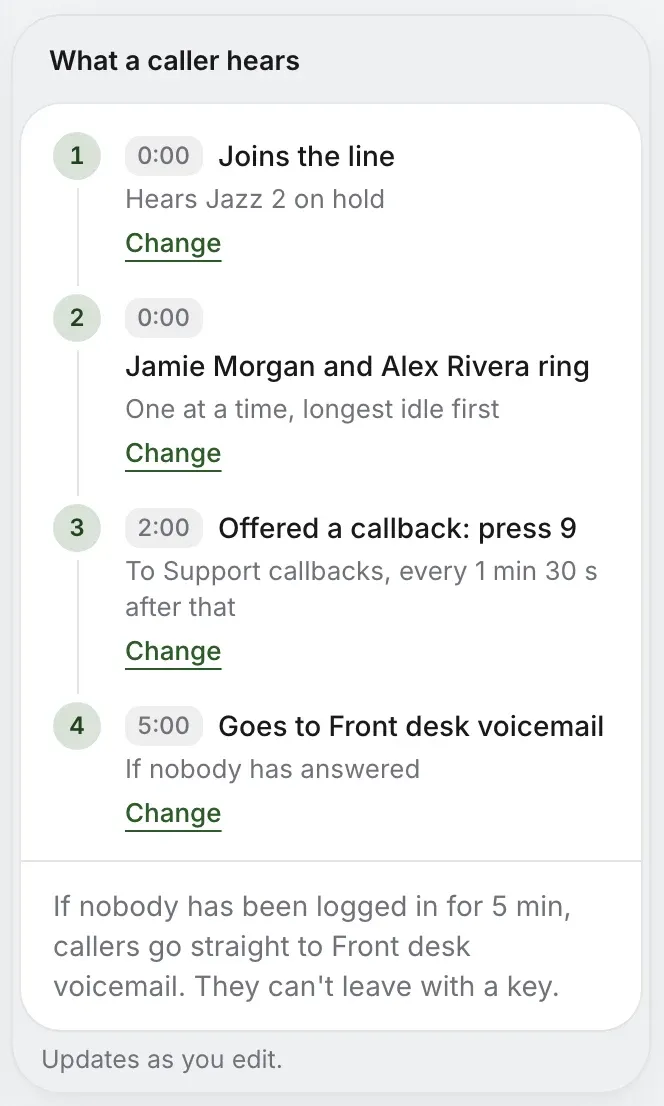
Turn on Offer callbacks on a contact center queue. Choose when it first plays, how often it repeats and which key takes it. What a caller hears updates as you edit.
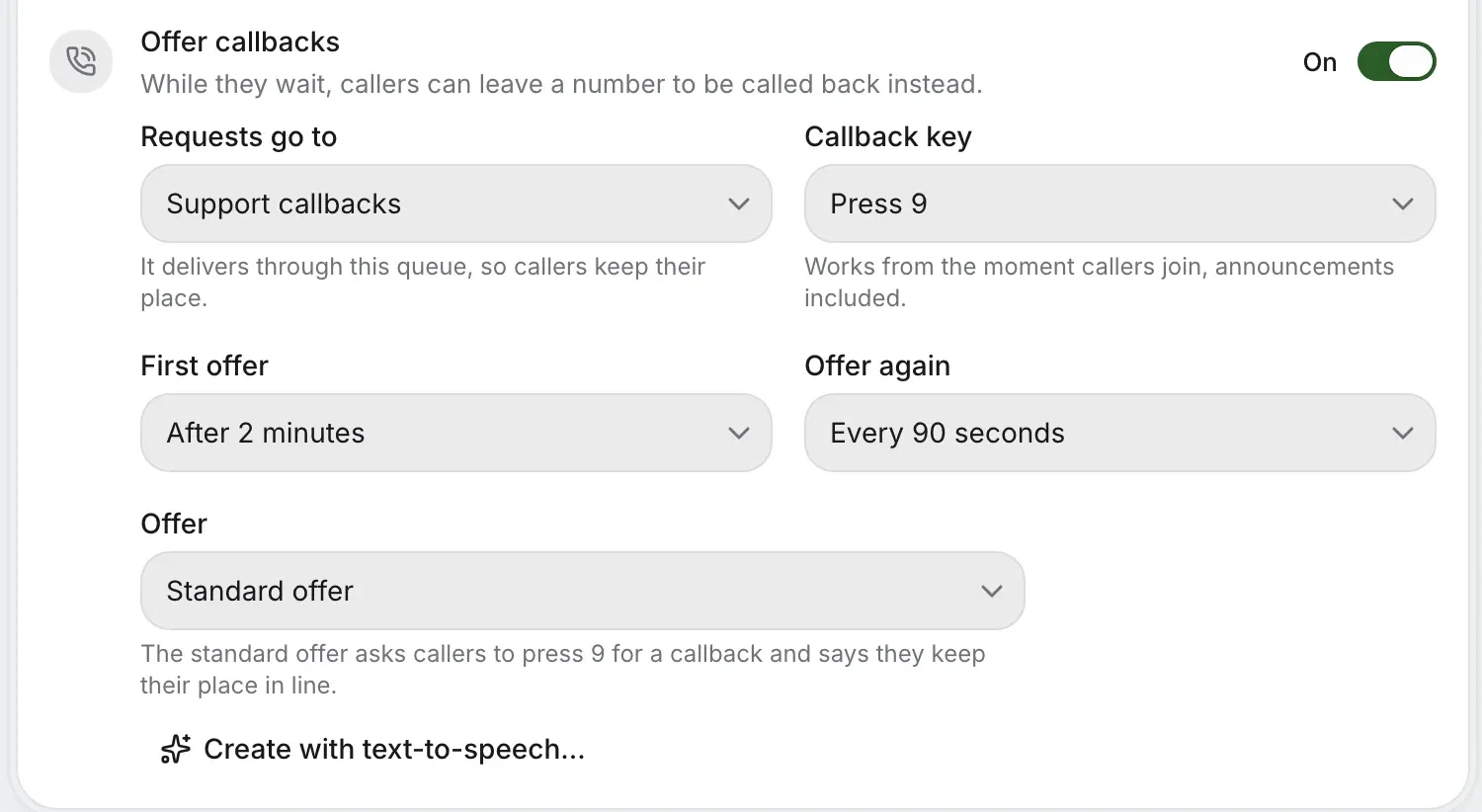
A queue’s Offer callbacks, on: requests go to Support callbacks, press 9, first offer after 2 minutes, offered again every 90 seconds, and the standard offer, which says callers keep their place in line
What a caller hears: joins the line at 0:00, two people ring, offered a callback at 2:00, press 9, and at 5:00 goes to voicemail if nobody has answered
  • First offer. After 2 minutes unless you change it, or right away.
  • Offer again. Every 90 seconds unless you change it, or only once.
  • Your words. The standard offer, or a recording of your own.

Two kinds of list. Switch any time.

Switching keeps the requests waiting, with their place and their expiry.

Automatic

Through a queue.

A contact center queue offers each request to its agents, like a caller. Nobody dials until an agent answers. Requests expire after an hour unless you change it.

Manual

By hand.

Requests wait until someone presses Take, then that person’s call dials the customer. Good for after hours: they keep for 3 days unless you change it.
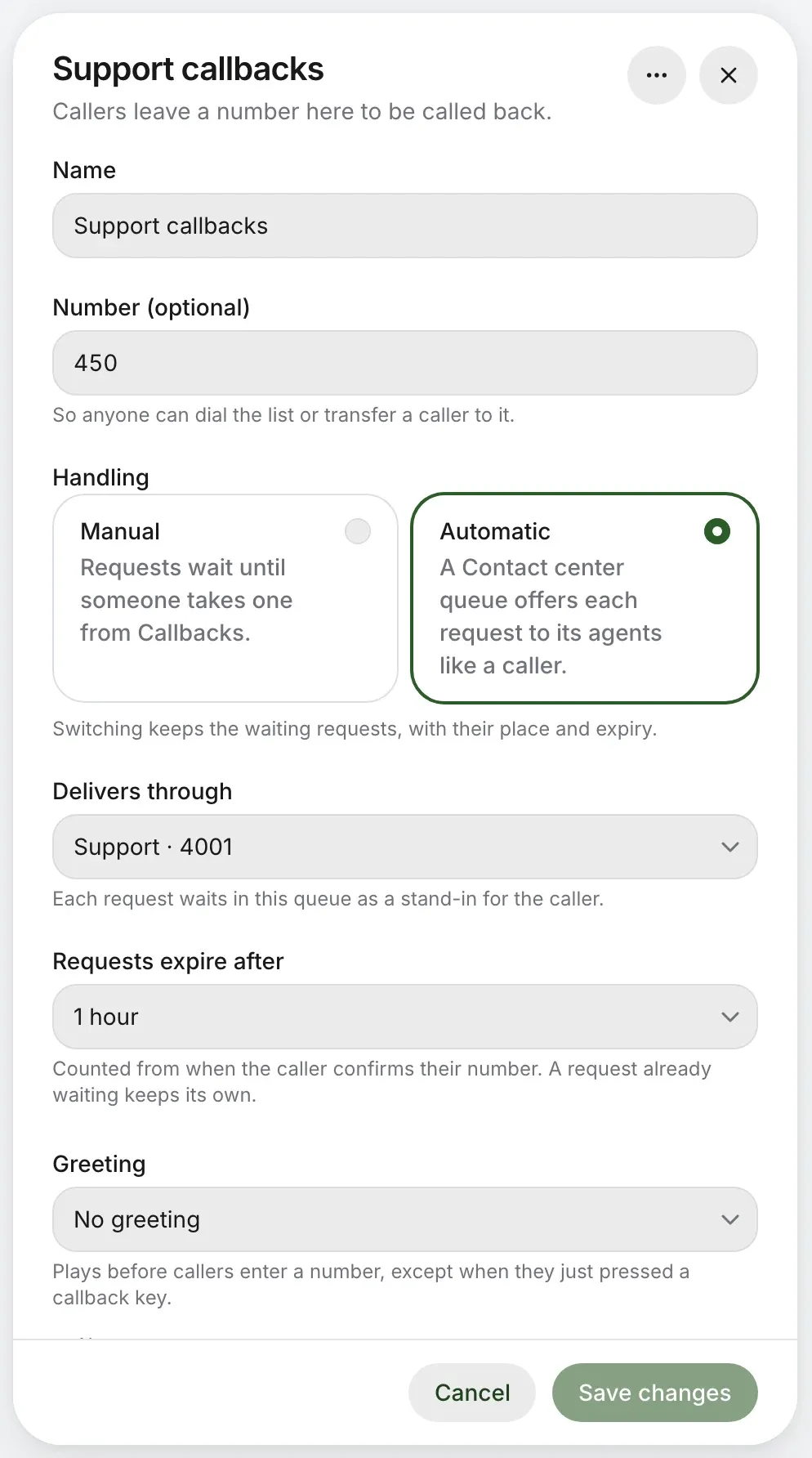
A callback list: its name, a number to dial it on, Manual or Automatic, the queue it delivers through, when requests expire and a greeting

Not only from a queue. From anywhere a call can go.

A callback list is somewhere to send a call, like a menu or a queue. Whatever can send a call somewhere can send it there.
  • A queue’s key“To keep your place in line and have us call you back, press nine.”
  • A menu option“Press 2 to leave your number.”
  • After hoursA closed route goes straight to the list.
  • A long waitA queue’s timeout can end there, not in voicemail.
  • Its own numberAnyone can dial the list, or transfer a caller to it.
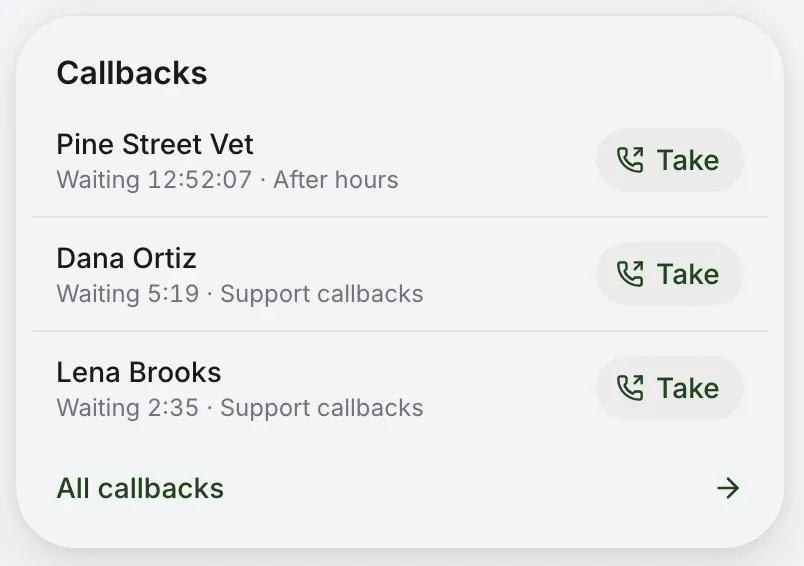
The Callbacks list from the portal’s pill: three callers waiting, each with how long, its list and Take

Whoever’s free takes it.

Everyone who can make calls sees every list, and can take any waiting request. Take claims it first, so two people don’t call the same customer.
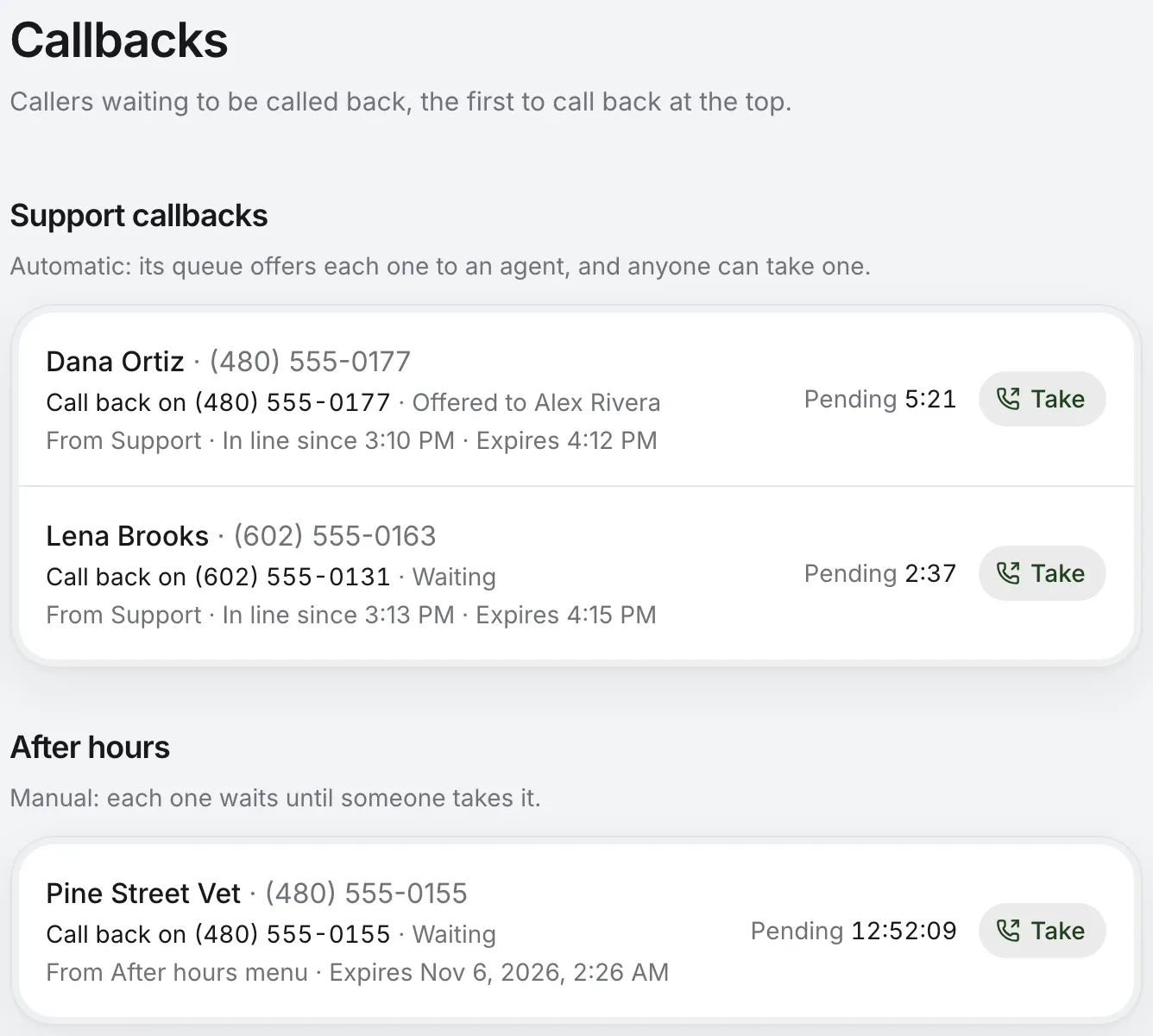
Callbacks: an automatic list whose queue offers each request to an agent, a manual list waiting for someone to take each one, and for each caller the number to call back, how long it’s been pending and Take
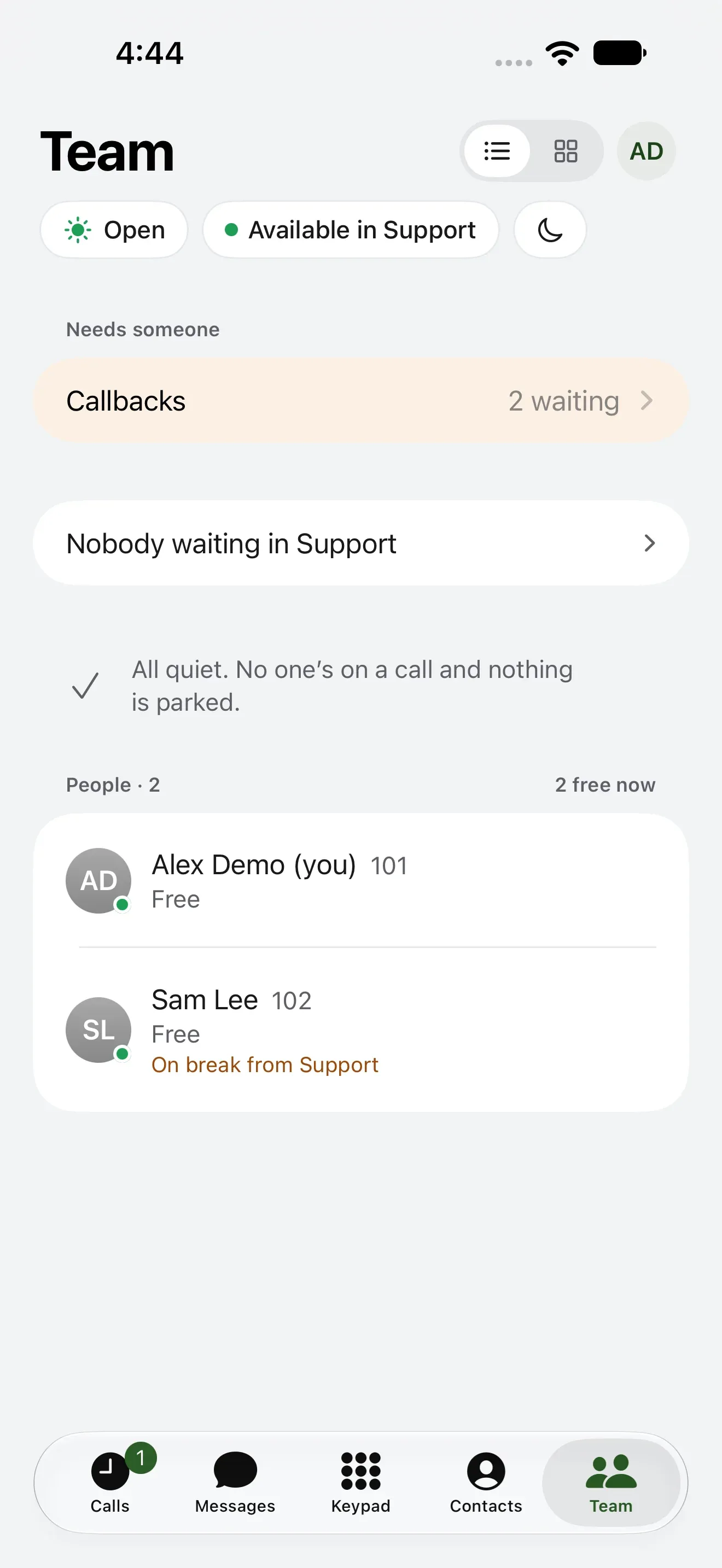
The iPhone app’s Team tab: under Needs someone, Callbacks with 2 waiting
  • In the portal. A Callbacks pill shows above Call while anyone’s waiting, the longest wait first.
  • On the board. Each queue on the live board counts its callbacks.
  • On the iPhone. A push for each new request, to the people you choose, and Take in the app.

The small print. Said plainly.

  1. One try. Kafono dials once and rings for a minute. No redials, so nobody gets chased.
  2. One request a number. Asking twice on a list links to the first request, and keeps its place.
  3. It closes itself. If they call again and someone answers, the waiting request closes.
  4. It has a limit. From 1 minute to 7 days, set on each list. Past it, the request closes without a call.
  5. It doesn’t watch the clock. Requests can wait past closing. There’s no scheduling for tomorrow morning.
  6. They know who’s calling. Their phone shows the number they called, as long as it’s still yours to use.
  7. Only US and Canada numbers. Never toll-free or premium-rate, so a callback can’t run up a bill.
  8. It’s all written down. Called back, Callback not answered, Callback busy or Callback expired, in call history.

In call history, the call that asked says what came of it, and the callback is its own row.
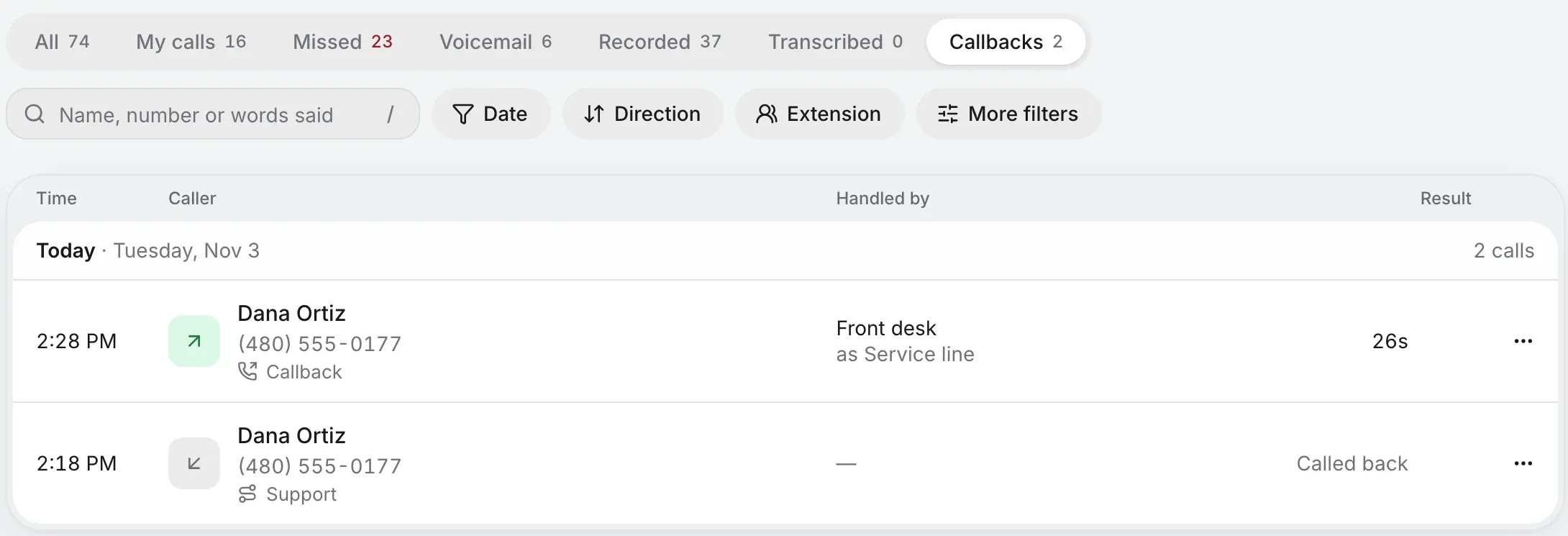
Call history’s Callbacks view: Dana Ortiz’s call to Support at 2:18 PM with the result Called back, and the callback itself at 2:28 PM

Questions about callbacks.

Do callers really keep their place?
Yes, when a contact center queue’s callback list delivers back through that same queue: a stand-in holds their place, and the queue’s offer says so. On other lists, a request’s wait starts when it’s made.
Which queues can offer a callback?
A contact center queue offers one with a key, 9 unless you pick another. A simple queue’s exit key, a menu option or an after-hours route can send callers to a callback list too, where someone takes each one.
What if the caller doesn’t pick up?
Kafono dials once and rings for a minute, long enough for voicemail to answer, so your agent can leave a message. Busy or no answer closes the request, with what happened in call history. There’s no automatic redial.
Can they give a different number?
Yes. They key it in and hear it read back. It has to be a US or Canada number, and not a toll-free or premium-rate one, so a callback can’t run up a bill.
Who can take a callback?
Everyone in the account who can make calls, from the portal or the iPhone app. Pressing Take claims it, so two people don’t call the same customer.
What about after we close?
Requests can wait past closing, and they don’t check your hours. Pick an expiry that fits: an hour unless you change it on an automatic list, and 3 days on a manual one, which covers a weekend.

Give callers their time back.

Check your business number. Callback lists come with business phone.

No number yet? Pick a new one

Rather talk it through? Write to us and a person answers.